If you live with chronic pain, you know it requires lifestyle adaptations that are viewed foreignly by others. Medical and holistic help is necessary. It can get expensive which may encourage us to take jobs that mentally harm us, exacerbating the experiences of chronic pain rather than allowing us to heal. I recommend finding a doctor and holistic community that you trust in order to overview and bounce experiences off of.
Here are some of the things I found helpful.
1. YOGA NIDRA/ BODY SCANS
Sleep. Sleep. Sleep and Restore. We do not get enough R&R with EDS and in general. Yoga nidra provides the body with restoration. Two hours of it has been found to equal eight hours of sleep. For years with insomnia I replaced sleep with nidra and restorative yoga and this helped my body recover. I also practice legs up the wall, a restorative pose that offers similar benefits to yoga nidra. It helps return blood flow in the legs to the core. I find these inverse poses help my lymph, circulation and brain fog. When I do them, I no longer have cold extremities.
– insight timer has good nidras including my own.
2. Myofascial Release
- painscience.com
- Tom Myers
- Myofascial rolling toning and stretching
All of the above are needed if you experience myofascial pain syndrome. This is when you get trigger points that if you touch have referential pain. It is also found to be helpful for fibromyalgic pain. Those of us with EDS may have both. The more you know about the body and alignment, the easier it is to care for your chronic pain. Learn your optimal alignment and start to track tension and pain through your fascia. I find that when something releases I get light headed for a bit and it triggers orthostatic intolerance but then it heals and I have more mobility, less migraines, less tinnitus. I am also a yoga therapist that trained for over 6 years in these techniques.
If you get the opportunity to learn and study, I would recommend it. For EDS I found pulling my skin at trigger points and needing them like a cat did more long term release than deep tissue. Deep tissue is too painful. I purchased cups for cupping therapy and use them at a light pressure to avoid bruising and put them on the trigger points so I can relax into a parasympathetic state while the exact trigger point gets treated. The reason it is hit or miss with professionals is because they are doing their best to guess at the trigger point through all our scar tissue, it’s hard–pun intended. If we can find them, we can show them or learn to care take ourselves.
- yoga tune-up balls if these are expensive get a no-name brand, tennis balls and a partially deflated bouncy ball.
- anatomy trainsThis book by Thomas Myers helped me undo the impacts of being hit and dragged by a car. I still have to care take daily, but I don’t feel like I’m being struck with knives any longer.
3. Care for the autonomic nervous system
- Abyanga.shirodhara, chinese acupressure, pranayama all help relax us and stretch/ release and tone connective tissue. As moving into a parasympathetic state, for those of us with dysautonomia, can be hard. I had to build my pelvic floor with breathing techniques (Pranayama) because it was too stretchy. Some birthing and doula techniques for post-natal care are helpful for toning the pelvic floor, one factor in chronic digestive, SI and low back pain. To be sensitive I would contact a teacher about working privately and not enter those spaces unless you have just given birth.
- Abyanga and shirodhara, ayurvedic hot oil massages, if done well help regulate the pineal gland. I have relax more deeply than I have ever in my life when these techniques were done on me at the California College of Ayurveda during my bodywork intensive. That stated I have not achieved such results elsewhere. My session and training had it done for forty minutes with rosemary infusions, a plant that I respond strongly and positively to. Rosemary has been found beneficial for those with brain fog and issues with working memory. That may have been luck for me. This is why community is important. Find people willing to explore.
4. DYI support braces/splints
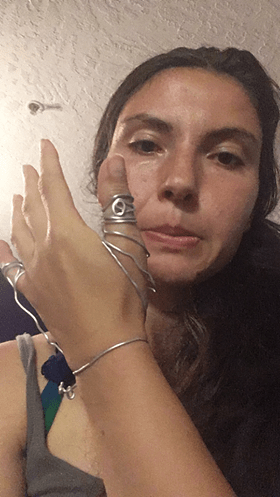
- I don’t like the cost of support braces of the look, so I get hypo allergenic crafting wire and make support wraps that look like jewelry. This has been helpful because I can tailor them do to acupressure on my trigger points. It is also cheaper. When pain travels I can rewrap and alter which works well with my myofascial pain syndrome. I also get long pieces of soft and stretchy fabrics and make wrap around shirts that provide support for my shoulder blades. I’ve been doing this since I was nineteen. I now know why.
5. Diagnosing symptomatic mental struggles such as ADHD and dyslexia to get help.
The more I understand EDS, the more I personally start to view some psychological disorders as related to gene mutations and expressions. Brain fog and dislocated joints, some that impact the ocular nerve, fingers and orbital saccades makes reading and writing really exhausting. I’m not bright and lazy. I’m bright and exhausted. Focusing takes so much more energy when I have to make eye muscle movements. Getting diagnosis so that the support like screen readers, dexedrine (which really helped the mental fatigue) and other medication is a game changer. We aren’t built like most people. We need to stop trying to be them, or we’ll hurt ourselves.
A mistake I made was that when I started dex I could focus so I stopped exercising on a routine because I used exercise to help me focus in the past. I ended up getting really bad blood pooling in my legs and insomnia. Start with low doses, be followed by a doctor and maintain exercise.
Einstein, Leonardo DiVinci, Anne Rice and Erin Brockovich are all dyslexics. The results of what we struggle with say nothing about our capacities and compensations. I use synaesthesia to process information and can’t do it in rooms in which I am being watched, monitored or examined because I’m too self conscious to enter flow space. No need to stigmatize needing help to do the functions others do easily when we are doing functions that few others do automatically.
6. Anti-histamines and Nettle Tea
Mast cell activation! Holy guacamole! Talk about my two weeks in anaphylaxis. After being institutionally abused I spent two weeks in anaphylaxis unaware of what was happening to me. It was during covid, so I thought perhaps I had it as those around me had symptoms of it. Maybe I did, but they weren’t testing in Victoria unless you had a fever. As we struggle with blood flow, my temperature often drops when I am unwell and my blood pressure raises. Without dexedrine I have lowish blood pressure 62/97. Dexedrine brings it up to “normal” 92/100 and that feels fast for me. When I get mast cell activation, my keloids tingle, my body pusses from places I didn’t know pussed, my lymphs swell, my GI track feels like it’s being carved out, I can’t stand without fainting, I get irritable, I can’t breathe, it feels like my face is tingling. Talking, words…what are those? I can’t, I don’t know. My trigger is nickel in foods, in dust, in gravel, in jewelry, in clothing. I have special no nickel clothes now for when I’m sick and I take four anti-histamines a day after a spell and then trickle down and replace it with nettle and fewer anti-histamines. I’ve eliminated all high nickel foods which has helped my ache and colon pain as well.
7. Compression pants and breathable clothing
- I switch between compression pants and ankle bands for support to super soft and breathable clothing on bad days. I usually where yoga pants under my jeans because I teach and it makes changing faster. This likely has also helped my symptoms as stopping over covid increased my orthostatic intolerance.
- My friend with POTS really likes the compression tights. My mom used the compression socks and got me a pair when I was a kid before she died. She found it helped her and I definitely preferred them to my other socks. Clearly, compression socks alone will not save you if you have vascular EDS but they can make a difference.
- I fantasize about the support shirts with align technology. and the leggings. I just wish there were ones where the lines looked like tree branches because I am hippy like that.

8. Saying “no” to environments and practices that trigger brain fog
I say “no” to loud music. I say “no” to bright lights. I say “no” to diet advice that does not consider the my systemic nickel allergy or that I have a collagen mutation. I say “no” to men who wear strong cologne and women with strong perfumes or I leave the space if they are defensive about it. I say “no” to fonts that are difficult to read and to reckless individuals. No, no, no, no, no. I say “no” to people who think that these disabilities aren’t real because they cannot be seen.
9. Allergy test and say “yes” to trying things and testing them out for a period of time and evaluating.
I found Acetyle-L Carnitine, CBD oil, vitamin C/Iron mid-day and a Lion’s mane formula I made based on my nerdings in herbology and my symptoms presentation effective in reducing my brain fog and low blood pressure for when I need dexedrine breaks to reduce tolerance. Everyone with EDS is unique so I’d be nervous about marketing or boasting about my blend. It contains Lion’s mane, bee pollen, dandelion root and salt/coconut sugar balanced ratio, but if you can study plants look into their properties and learn what pharmaceuticals are modelled after some alternatives may be available to you. I maintain the use of pharmaceuticals so I can be followed by a doctor, but CBD oil (as pure as possible) has really helped my inflammation. Naproxin and Ibuprofen are the only pain killers that work for me, but I get ulcers and have even before my use of them and they can trigger ulceration, so in essence I exchange one form of pain for another. Instead I tried CBD oil used topically made in MCT (coconut) oil which also helped and I use it to reduce the amount of pain killers I take. I also find that typical cooling analgesic salves that use camphor and menthol don’t work as well as clove for me. Go for allergy testing and get to know the properties of essential oils and what they do, you can blend your own salves and mists or work with a professional that can do the research for you. I am leery of learning from workshops from companies with “pyramids” as sales is their goal. So often some of the ones like camphor and vetiver that are supposed to help with my conditions make me want to vomit. For me peppermint helps nausea, my mandarine blossom/Jasmine pure mist helps mental stress. I massage rosemary into my hair before exams. I don’t know if that one works but I had an A+ average in university which is an improvement from high school and the ritual of self-care before an exam helps.
For personal guidance in Essential oils Contact Michaela Ritchie:facebook @parfumsolfaction or email: michaelaritchie3@gmail.com.
9. Resistance bands and strength training
I lift weights! You couldn’t tell by looking at my body if I don’t tighten my muscles and ask you to feel, but I do and it has been very helpful. I switch things up at the gym, sometimes toning with pilates like exercises. Sometimes one-upping the bros with my phenomenal weight to strength ratio. Sometimes targetting problem zones and their antagonistic muscles. My big safety practice is that I don’t use machines in which I am too small for. Because I am 5’1″, I semi-dislocate my shoulders in reaching for things often. So if I’m too short to reach a handle with my feet properly placed, I grab steps to place under my feet and raise the seat or I don’t use that machine. I start higher and reduce as I fatigue, but when I started weight training I started lower to test my capacity. If I’m weak one day, I don’t judge I adjust, my body works hard enough, I don’t need to be critical. I really like the exercise balls, sometimes I play with them for hours. I treat the gym like a playground. Exercise is not discipline, it is self exploration and play and when we play we assess boundaries.
 kind movement. Compassionate mind. Empathic research.