Changing the dialogue around Fear
…A Personal Anecdote
When I was a little girl, wonder felt overwhelming at times. At heart I was an explorer with the inquisition of a scientist. I remember staring up at a wooden tower at the park that did not have stairs. You were supposed to climb the rails of the draw bridge and sneak your way up. A great accomplishment if you did. Few children tried. I wanted to. I wanted to be in that quiet tower, far away from the the games of tag, safe in my imaginary world of play and observation.
BUT, climbing the tower meant I could fall, something might break!..and then maybe I’d cry and upset the adults with my injury or emotions. I had to look at the tower from every angle, practice climbing on the rails until it felt like second nature. A lot more things make sense now that I know I have EDS. What I thought was anxiety1 was the perception of actual danger2.
That stated, the dialogues about my developing identity were as such: Jocelyn is not a very active child. She is a real girly-girl and doesn’t like to explore much. It wasn’t my truth; it was their story. I was exploring, but with a more fragile body I had to learn some safety making behaviours before I could take risks that were big for me. My fear of falling did not inhibit my desire to climb, but the belief that doing it slowly meant disinterest then limited the opportunities I was given to climb.
Later in life, I took up bouldering–going slowly at my own pace and risk assessing. I am still afraid of falling. However, by leaning into the fear and assessing my situation, I have learned that falling is okay. Falling, sometimes with injury, sometimes without, taught me about risk assessment so my fear responses are less generalized. Thus, in order to feel safe one has to lean into fear, not as if it is an enemy, but as if it is an internal guardian capable of a dialect.
I embrace fear because if I treat fear as if it should be avoided I have already made an enemy of it. Fear tells us to be careful with ourselves and others. It teaches us how to avoid or attenuate danger when well attuned, but it requires tuning. And in order to fine tune our fear response, we need to converse with those uncomfortable feelings.
Having a dynamic relationship with fear is fundamental to having compassion to those that have harmed us. I state this because fear assessment helps us decide if the danger is gone. This is necessary in establishing boundaries on how to forgive. Do we forgive and reestablish a bond or maintain distance? A person that has successfully grown will not pose the same threat as they did before their evolution. That stated, we need to assess and assessment takes time and energy.
Assessing safety and danger?
Safety, in my opinion, is an assessment of trust not only in ourselves but our environment. Trust3, by definition, is the reliability in someone or something’s strength, ability and accountability. Trust exists multidimensionally to encompass mental, emotional, physical and spiritual safety. When we feel safe there is trust. We can connect. It requires honesty from our surrounding to admit their shortcomings and therefore to brave vulnerability. Safety cannot be forged through defensiveness. It is harboured and cultivated over time, predictability and consistency.
When assessing safety, we need to be able to trust that we can handle and bounce back from environmental press5 ,that is the weight that the world asks you to carry in contrast with the resources you have to carry it. If the weight is little and you have the resource to manage, it’s all good. If the weight is too much and the resources are sparse(sparse resources)6, maintaining safety is nearly impossible.
In order to feel safe we need to assess whether someone or thing is dangerous to us and if we can bounce back from the press that has been put on us. Safety therefore works symbiotically with compassion, as compassion buffers the impacts of stress. If we have safety, we trust our resilience, so if we sway from our baseline7, we trust we will return to it. Self-compassion8 provides us with resilience against the environmental stress and helps us return to baseline after experiences of danger.
On the other hand, an environment can be unsafe, or we may need to assess safety because it is ambiguous. If an environment is dangerous, we need to converse with the fear it elicits to respond appropriately. This requires us to pause and assess, which means we need to trust resilience because we may or may not be in imminent danger. Thus, we need to have strong relationships with ourselves and strong self-understanding. We can cultivate this through psycho-education and self-exploration. Ignorance towards our nervous system can make or break or feelings of safety, thus vaguely understanding how emotions are neurally processed can help us construct a helpful narrative.
Emotional circuits: fear, safety and compassion
In Paul Gilbert’s book, The Compassionate Mind (a coincident), he tells us about the three theorized circuits for emotionality:
1.Threat
2. Drive
3. Soothing
These circuits work in junction with one another arguably for the perpetuation of our species. That stated, I believe evolutionary psychology has taken their perspective on the threat system too far. The domain claims that the threat system is pertinent for survival because it allows us to fight-flight-and-freeze9 in the face of danger. Further research shows that it also controls the tend-and-befriend10 response.
While there is truth to the statement, these can perpetuate survival, it is not the only means of doing so. There are two other circuits that Gilbert refers to: drive and the soothing system. By balancing these three systems we an access compassion. In later research, Gilbert seems to add a forth state of equilibrium or contentment. I will have to research more to make a conclusive statement about it, but he seems to be suggesting that beyond soothing, there is a state we can enter when our needs are met, and we are content, similar to the yogic notion of Santosha11.
First, one must get out of danger, that is the threat response, combined with the drive response. You run before you can internalize a judgement, we are driven to survive. Then, one needs to sooth.
Soothing begins when you realize you are safe. We switch from threat assessment and drive to deepening our breath and self-talk. In cases of trauma, too often we persist with the beliefs that circumstances are bound to repeat themselves. Sometimes that is the case and other times it is not. We need to assess ambiguous stimuli such as dogs–some are friendly others are violent, some change over time, just like people. People do exhibit different behaviours with efforts overtime, this can be hard on the threat system because it makes people ambiguous12. It can help strengthen the soothing system overtime to view these changes. That stated, the environment needs to be safe. This means the environment needs to prove itself worthy of our trust, meaning the resources are provided for us to maintain resilience and bounce back.
We also have a human need to connect and if a person or community cannot receive or provide soothing because their nervous system does not allow it, or the cultural nervous system does not allow it, mental illness rises. To create safety we need to move away from the narrative that people are stagnant and unchangeable, that safety is flight and fight when in reality too much fight and flight escalates danger. In order to create safety, we need to start understanding the path to get there.
…The three systems in more detail.
The Threat and Drive System
How It functions
The threat system functions using cortisol and adrenaline.
It is stimulated when the external environment is processed via the amygdala13 with less response from the hippocampus14. This happens when we are in the face of actual danger, when we are triggered emotionally and when stress has caused us brain damage to the hippocampus and limbic system.
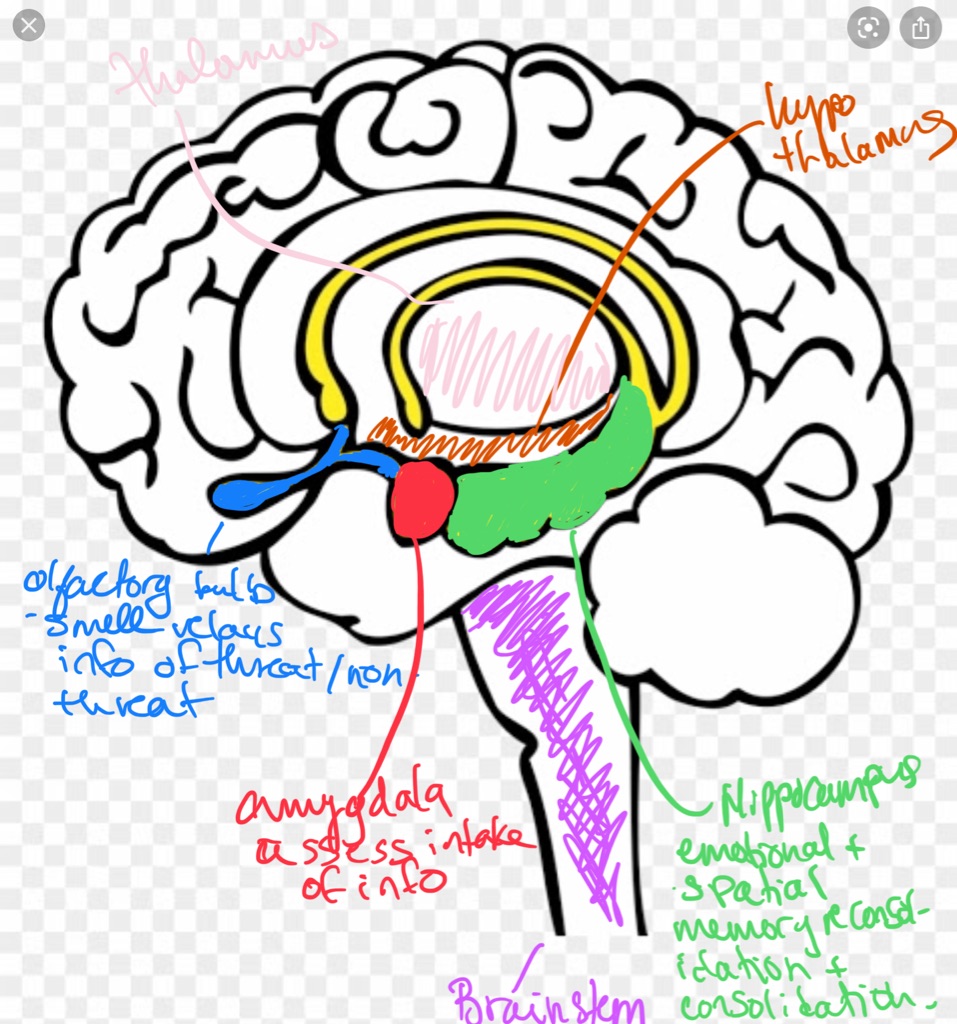
It gets over activated when cortisol has caused inflammation and deterioration in the hippocampus which reconsolidates spacial and emotional memory. When we cannot access past memories due to dissociative amnesia3 or dissociation14, it can be hard to improve our responses to an upsetting stimuli. I suppose this is because we cannot access memories that elicit a soothing response.
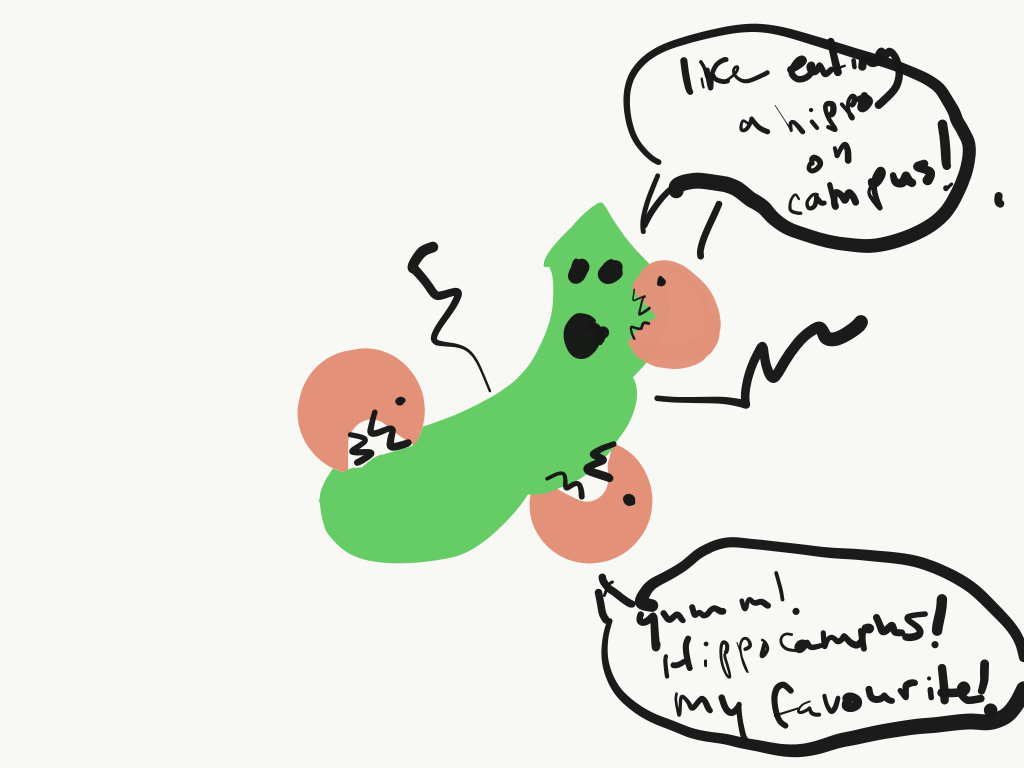
Triggering the soothing system and when we cannot.
To intuitively circumvent the threat system, our brains pull information from our cortexes in order to assess threat and consolidates it with the info of the new stimuli in the hippocampus. When this happens we ask: “is the threat valid?” “Do we have enough information about the threat to decide whether it is a danger?” “If it’s not a danger, we can take those deep breaths.” With a reduced hippocampus- the threat system dominates because we do not have access to parts to recondition our emotional response. Luckily there is ongoing research in neuro-regenerisis which is finding that the hippocampus can, in some cases, be restored but for that to happen we need to find or create safety.


“We need to distinguish volatility from abuse.”
~Jocelyn Townsend, thoughts on Feb 25th, 2020.
To create safety we need to assess for safety, the same way we assess for danger, but rather than asking “is this dangerous”, we ask, “is this safe?” Safety doesn’t exist when immersed in an abusive atmosphere, at least not for the parties being abused.
Responding to or witnessing someone else’s threat response means needing to feel safe within your skin so that someone’s flighting, fighting, fawning, freezing can be appraised as either abusive or as a violent setting of boundaries. This is done by assessing power dynamics. Is someone volatile because power is being used over them abusively and cannot find a way to exit the dynamic without enduring harm? Is someone misusing their power by displacing aggression on someone less powerful? Or, is someone fighting for their right to exist and just fed up?
We poorly train our emergency responders for traumatic situations. If we want to end violence, we need to sooth and have compassion inwardly and outwardly. We need to distinguish volatility or violence from abuse so people without power over can grieve and heal and power abusers can grieve and heal. To be on either side of this dynamic requires the spiritual practice of being in two places at once. The Yoga Sutras14 claims this is one of the learned capacities, or Siddhis, of the the yoga practitioner. It is considered to be like a superpower. From my experience it is an emergent automatic process that spontaneously manifests. The esoteric Siddhis can be understood metaphorically as being in the state of expansive compassion15 while bearing witness and literally holding the hyperarousal of others until they can co-regulate with you.
Compassion requires some degree of safety within ourselves, within our souls, practices and in the world. For compassion to expand, safety is necessary to circumvent burnout. As it becomes too costly to show compassion to those that continue to do harm, we are left harmed, angry and volatile as our kindness contracts from the abuse. This is why having good risk assessment is valuable. Compassion and safety go hand-in-hand. To show compassion to someone, the environment needs to be safe. If the environment is threatening, compassion is hard to uphold because the environmental press is weathering.
When a system isn’t safe
The justice systems assess situtations of harm and relies on the assumption of a type-2 errors16 as it is assumed less harmful. If the null hypothesis “Is so-and-so guilty of having been abusive”, the type-2 error mean the “non-rejection of the false null-hypothesis when it is indeed false”.These statisticians are not word people. In clearer words, it is stating someone is not at fault when they are indeed at fault.
A professor I had even stated once that you do not want to make a mistake and harm an innocent man when there was no error in the first place. This is incredibly problematic on three accounts.
1.Why are we fearing harming people in a system that uses the word justice?
2. The assumption that type-2 errors in cases of power abuse such as sexual violence is less harmful than assuming guilt.
3. One can assume a type-2 error in these situations without subjecting the person who was abused to further harm.
Simply stated, the false null-hypothesis is “Is so-and-so not guilty”, the non-rejection of which is “[I do not reject] that so-and-so is not guilty” which is the foundation of the justice system if you are a white-cis-straight-man, in essence what the statement “innocent until proven guilty” infers, when equated with social justice, is that accepting guilt leads to punishment and that punishment is justice. Therefore guilt cannot be presumed without hard evidence.
But is this true? Is punishment justice? Does the sadistic pleasure derived from kicking your bully in the face make you feel better? Does it take your pain away to watch others suffer? No, but neither does doing nothing, because in the face of victimization and survivorhood, we are not thriving, we are merely surviving. Vitiating the threat system and scaring someone into compliance does nothing but uphold harm and danger.
Only in a system that equates justice with punishment or cruelty is a type-2 error fundamentally safer than a type-118 error, because there should be nothing to fear in assuming guilt. Assuming guilt should be accompanied by the relief that having done something wrong leads to rehabilitation and a better life. Guilt should be assumed by everyone with emphasis on those who wield power.
The statement my prof was making is that we don’t want to assume the guilt or shame of subjecting cruelty to an innocent man. However, in a system that relies on dichotomies, this implies it is better to assert cruelty in the form of blame, shame, and gaslighting on the “complainant” than it is to assume a type-1 error. In circumstances in which the complainant was conscious and awake to witness the account, you cannot assume a type-2 error without making the victim into a villain or otherwise a ditz. Both these assumptions are rooted in misogyny and to villify a victim who has already undergone harm perpetuates the re-victimization. Their feelings of not being safe amplifies as those who embrace them as a villain treat them as such. So in effect abuse done by a singular person becomes abuse done by a pluralistic institution with many bureaus and staff members.
The justice system’s focus on “cold facts” and “credible eye witness statements” become problematic because a phlegmatic17 approach to assessing guilt, in nature denies the impacts on the nervous system as viable evidence. The notion that a nervous system undergoing sudden change without neurodegenerative disease is not a “cold fact” is arguably as ignorant as denying climate change, possibly even more so. It becomes further damaging because the victim’s statements are treated as if they are possibly untrue and require evidence to prove. While this is problematic for any complainant there are those that are at a greater disadvantage, such as the disabled community.
In my own case, Jennifer Russels seemingly discredited my statement that I went to my assailant’s office hours, because I had to book office hours which is a common protocol in summer courses. The investigator on my case, Jennifer Russells, suggests his accounts, in which included many “I don’t remember” were more accurate than mine because of my choice of semantics and struggles on a very limited form to write as many accurate details as possible of the events that were witnessed. She seemingly asserts that what I went to were not HIS office hours, as they were appointments and thus my eye witness statements lose credibility. She refuses to speculate subtext, as it is not cold fact, which his was that our 2018 meetings that initiated my discomfort with him never occurred, despite evidence of the contrary. In essence, he was instilling doubt of me to protect himself. But why is he protecting himself? The outcome of assuming guilt would be a slight reprimanding and making sure that I could get the courses that I needed when I needed them and some form of community accountability.
Jennifer Russels does what the legal system does best, lawyers argue cold facts to dismiss statements because they are protecting their client from the threat of punishment, whether or not there is punishment for the problematic behaviour. Arguing cold facts then relies on issues like Semantic replacement19 to discredit statements. Semantic Replacement has been recognized as common even in those with highly superior autobiographic memory. Furthermore, I, like many have a diagnosed language disorder and struggle with word retrieval even when I am not traumatized. So anyone that struggles with neurodiversity20 in this system is at an automatic disadvantage. So, even with policies in place that state it is within our rights to live without systemic discrimination, the structure of the system denies that right.
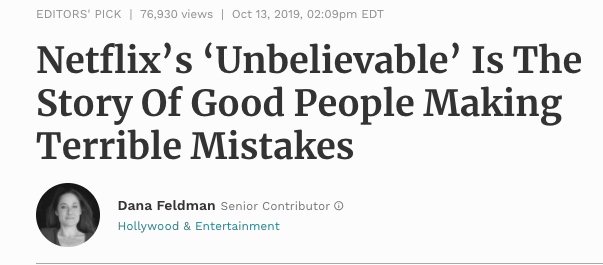
Above is an article about poor risk assessment. “unbelievable” is about the failures of a town and police department to help a survivor because people didn’t want to believe her. When people don’t believe survivors it is generally because admitting to the harm that was done to an innocent person means that you are somehow vulnerable to that harm, the uncomfortable feelings or the survivor’s guilt. This is an example of poor risk assessment because assessing risk does not just mean assessing the risk to ourselves, it includes assessing the risk for other people. As it is those outside of ourselves that comprise our environment.
When we fail to believe the statements of survivors because it would tarnish our sense of safety in the world or elicit our own shame for having either failed to protect the innocent or having done similar “rapy” or misogynistic acts, we fail to assess the risk that dismissal has on wellbeing and risk community rehabilitation.
“Denying the parts of ourselves and culture that are broken does not protect anyone from stepping on the shards.”
Jocelyn Townsend- Feb 26th, 2020, cited: my thoughts.
In her book, I thought it was just me, but it isn’t, Brene Brown depicts the affective shame we commonly feel when someone is wrongfully violated. This leads to victim blaming29 behaviours. Many of us don’t want to think that randomly abusive acts can happen to innocent people because it makes us question our safety, our vulnerability or else we feel ashamed at our failure to uphold safety for someone else. However, ascribing to denial, victim blaming or even gaslighting21 victims in believing they are truly bad people deserving of punishment, schaudenfreud22, is the mindset taken on by jurors under the manipulation of defence lawyers who may or may not be ascribing to this mindset. I call this mindset “defensive distortions” because we distort reality in order to excuse the inexcusable. In those moments we attack someone else’s vulnerability and assert power over in the most harmful of ways.
When we employ defensive distortions, we fail to employ the more protective or compassionate perspectives such as: there is a lot of pain and suffering in the world and sometimes it lands on people who are kind and trusting or something about their physicality makes them vulnerable and the attacker needs help. Kind, trusting and vulnerable people deserve to be protected and abusive people deserve to be held accountable and shown how to get better. Some vulnerabilities do not just go away. If you are five foot, you are five foot. If you have a disability you have a disability. When we interpret the volatile suffering of marginalized people as an attack on ourselves rather than a reaction to systemic violence, we deny the existence of wrongdoing in the world, we inhibit the creation of a safer or healing environment. Furthermore, we gaslight, systemically.
The criminal justice system is founded on a the threat system and employs defensive distortions. Innocent until proven guilty23 is a dichotomy which is based on and elicits fear. Why are we needing to prove anything? Why can’t we just be guilty, accept the upheaval that arises and work towards remorse and reconciliation? Is this because guilt is used synonymously with shame? It is in a system of punishment.
A shame resilient culture is a compassionate and accountable one. When we aim to understand where abuse and violence stem from without taking it on, compassion helps us create safety. As alluded to in “The stories that define Us”, the compassionate narrative is not the dominant narrative in cis-straight-white-supremacy.
“threat system based culture<->Poor risk assessment<->diminished safety<->threat system activation”
-I will replace this with a web gif in the future, but not today. Jocelyn Tea.
We want to move out of our threat system so that we do not stay there and continue to self-harm or harm-others. The threat system also affects how we appraise stimuli, so regardless of thinking we are creating safety by being on high alert for threats, we are not.
When we get stuck in a system of threat, we have increased negative appraisals and increased startle responses. It is no coincident that this is also common in low self-esteem. When stuck in the threat system we internalize negative statements that have been made about us or others state about us. These statements may be true or not. In essence, over exposure to powerful systems of threat results in the symptoms outlined in the ICD-1124 criteria for complex post traumatic stress disorder25.
Police have over activated threat systems. In fact, I have been informed on wellness checks that police training include perceiving ambiguity as a threat. This leads to poor risk assessment and even more, the abuse of power over. If you are trained to believe the unknown is threatening, what is unknown and innocuous becomes startling. Given weapons, innocent people die, #blacklivesmatter.
(Stay tuned for a depiction of CPTSD.)
Running on the threat system, we learn to view the world as a threatening place or that it is a threatening place, rather than one in which threats ebb-and-flow. Because white-cis-straight-male-supremacy runs on a threat system and has been implicitly or explicitly trained to view us, those who are not them, as a threat, utility and lesser than, existing is nearly impossible for those who do not endorse their paradigm. (If you are a white cis-straight-white male reading this, pause if you get activated. THIS IS NOT AN ATTACK ON YOU, this is a call out on the cultural practices that have reaped you of your right to certain emotions, your right to feel and heal and relate to positively charged emotions that would improve your health, wellbeing and relationships. If you are holding yourself accountable to heal from the cultural core beliefs that grieving or allowing fear-and-safety to be fluid you are on the right track.)
The cultural threat system is excused by violence rates in the ghetto, and cultural differences such as varying lingo, music and attire that have developed to buffer the impacts of abuse, segregation, and victimization. It takes the impacts of living under an abusive hut and uses the impacts of abuse as reasoning for further ostracism (abuse). It is excused by the reactions of rape survivors, and the legislated protection of minorities (without this being reflected by action). It perpetuates out-grouping26 and the need to maintain out-grouping because those who view our existence as threats, through profiling, or as potential punching bags, and can get away with it are dangerous. In such dynamics, volatility from the marginalized is hardly an option, as it is elicited by the chronic activation of the sympathetic nervous system and results in temporary or permanent brain changes. Those who remain calm and complicit to authoritarian abuse for survival, do not do so without impact, marginalized groups have higher rates of autoimmune disease, consistent with the findings that high adverse childhood experiences cause epigenetic changes to the telomeres in your chromosomes, priming them for high inflammation and reducing lifespan.
Cis-straight-white-male-supremacy is founded on the same threat principal27 as toxic masculinity. Getting curious, I derived its’ origins from ContraPoints as deep masculinity28. Deep masculinity mythologizes that men needed to be cured from the “effeminate” impacts of modern culture which reaped them of their opportunities to connect with their primal-protective self. Deep masculinity correctly identified that there is a real problem euro-western culture, it isn’t working for most of us, but I disagree with their reasoning, have you watched hockey? Sorry, they had hockey in the 1990’s…I’m not sure where the belief men didn’t have means to aggress and defend is coming from. Blaming industrialization for a dysfunctional cultural nervous system seems like too easy a copout.
The problem of toxic masculinity is believing your own emotions are a threat because this teaches us to hate parts of our humanity. It divides us interpersonally and intropersonally, stifling our sense of safety, because if our own humanity terrifies us, how are we supposed to feel safe in the world or in our skin?
(I have yet to find the roots of patriarchy and white-supremacy because I am not a historian, but if you know or have resources, please send them to me, I will nerd.)
To deepen the sense of danger in the world, while war and violence may have decreased over the 20th century, warfare has not, it has evolved to a point in which generations have feared for the sudden and unpredictable ending of their lives. The increased ease at which we can be annihilated or suffer acts of violence serve as an additional environmental press on the individual’s nervous system. Safety is inhibited or else ignorance is required. When we disrespect and shame grieving and mourning and their healthy behavioural expressions, we prime little boys to grow up to be emotionally struggling men because we cut them off from the positive experiences and emotions that evolve from receiving comfort, support and connectivity– such as relief and gratitude. We replace gratitude with shame. This is an egregious loss as we need those emotions to access our own healing powers. As “hocus-pocus” as I put that, I mean what I say. The self soothing system which is related to neuroregenesis and balanced nervous systems allows the body to repair and grow. I will light a candle for those who have lost those connections every night…that I remember.
If you thought those two last points were food for thought, I have a third! Culture is shifting and despite the need for these shifts, change is terrifying to a traumatized nervous system. Porges, Polyvagal theory discusses six states of the sympathetic and parasympathetic nervous system. The threat system’s baseline is flight-fight-freeze, when change occurs, there then is hyper and hypo arousal, the end state of which onsets illness, and even death. That stated a soothed nervous system functions within a window of tolerance to the same stimuli. In recent years necessary changes have occurred; about 50% of marriages end in divorce, gay marriage was legalized, trans people can go to the washroom in some places and while these ostensible shifts have started, the cultural nervous system is still stuck in hyper-arousal because there has not been a large enough systemic shift into soothing.
People are walking around thinking they will be punished because of change, or that there will be less protection of one’s heterosexual relationship because women work in the world and the love between two women is legit. Some people believe that it is an attack on them that groups that have been othered or erased have to be acknowledged or have rights because it brings up the wounding that we have unintentionally harmed people for years and in a system of threat that is scary.
To exemplify: a cis-straight white man lamented to me once that he didn’t get why his childhood friend who no longer goes to karate after coming out as trans or why he couldn’t refer to him as “Sophie”, his dead name, anymore, and why he couldn’t just be “Sophie” “because at karate it wasn’t about gender or sex, it was about the movements.” I took this one on, but after unpacking it with my best friend and other red flags like referring to tree climbing as requiring “lots of testosterone” and that I climbed surprisingly high for a girl (five year old Jocelyn was very happy, but not with the statement), my emotional wellbeing would be better served elsewhere because one individual’s nervous system without support (see creating empathic spaces) cannot reprogram another’s nervous system without sacrifice. Or worse, one is sacrificed until they do that emotional labour because without it being done their identities are erased. This work is most often done free of compensation.
This man wasn’t heartless, but he did not have access to the emotional tools to process the guilt that he, for many years, unintentionally, caused harm to someone he cared about. And when we cannot process guilt, it lingers as shame.
Shame brings up the wounding of low self esteem and worthlessness and the fear of punishment. So what do we do then? We find counterpoints of defence and attack, including the reactions of threat and defence displayed by those who are systemically marginalized. So, how do we heal in a cultural nervous system that does not provide safety? We do not. If help rather than punishment were not the outcome of having done harm, people wouldn’t be afraid to assume guilt, but we have stigmatized human emotions as threatening and when that happens, we don’t talk about them, we look at the cold facts.
Just as the soothing system can give us a pat on the back for losing a game, the threat system can tell us that self-soothing or self-compassion is shameful. This is because some people want to skip over the process of accountability and go straight to self-compassion. So when we cannot make safety in such ways that it emerges from compassion, we’ll attempt to make safety by perpetuating harm. This does nothing good, but you might feel superficially conflated after and believe yourself a worthy defender entitled to affection, and praise; and if you convince those around you that the marginalized are indeed dangerous and rage without provocation you may even get that reward. The threat system rewards certain types of people and that is why it is sustained.
Not surprisingly, the threat system is fuelled by vasopressin, norepinephrine and cortisol. Vasopressin is actually related to love-making and attachment which informs me that the our DRIVE to defend, or simply put, our defence of our cultural threat system is a maladaptive defence of self-love or a defence of the archetype of the wounded child that needs love. The unfortunate coincidence in doing so is that the wounded child then matures into the self-saboteur28, making it harder and harder to receive connection from the outside world. Many would call that self-love narcissism, but I am choosing to be somewhat sensitive to the stigma associated with the word, as narcissism can be thought of as a developed form of the wounded child who never takes on healing. The movement to call out toxic masculinity is a cry for those who developed in it to detoxify for a group of people who live in fear of its’ repercussions. We cannot do the emotional labour, if you are not working on it yourselves. The difference is in the power afforded to those who profit off of white-cis-straight-male supremacy and those that are harmed by it, some of whom may be cis-straight-white-men, without mass recognition that the cultural is dangerous, this group of people will struggle to move into the soothing system.
Drive or motivation occurs when we are able to decipher what we want. If we appraise that shaming needs to be stop by annihilating threats or acting out of worthlessness to assert our dominance, we are fuelling the threat system and perpetuating the harm that harmed us in the first place. As a trauma survivor, I can tell you that as this happens, we feel desire to attack to gain back power or we feel we have to engage in a system to protect others and ourselves, such as the legal justice system.
Problems occur because the legal justice system is based on threat and is emotionally and psychologically illiterate– innocent until proven “shame worthy” should be the motto. A system of punishment cannot be a system of understanding, and when we do not build our juridicial system on understanding, engaging with it puts us in danger, even as complainants.
When we engage in it, as complainants, we feel threatened by our humanity and threatened by those that we hold accountable, despite our deserved accountability. My only empathy gap to responders are those who knowingly and continuously abused marginalized people because they know they can get away with it. I don’t have sympathy for you, but I don’t think the system is designed to make me safer from you or to heal you.
Being a complainant engaging in the cultural threat system is self-annihilating. We become the receivers of gaslighting and systemic violence, we commonly experience so much danger we may wish to annihilate our abusers, but that does not make us safe, so many of us think of ending things for ourselves.
This can help us understand suicidality. Remember, the overactive threat system leads to inhospitable conditions in our bodies, PTSD creates high inflammatory conditions, threats then becomes amplified. My hope is, as someone who lives with these very thoughts, is that in understanding compassion culture and immersing myself in it, I can get to a place where safety feels like home and home is safe. This is why understanding the link between compassion and the experience of safety is so important.
In understanding someone’s suffering, I become a witness “and/rather than” a receiver. I state “and/rather than” because you can bear witness to someone’s suffering and in a system of discrimination still receive the blows of their suffering. The spiritual warriors of the world are the Maya Angelous and other marginalized folk whose unimaginable resilience to succeed in a world that I have failed in leaves me awe-filled and on my knees. This is not done by choice and often with great sacrifice, it is done because it is hard to stay in an elevated state of consciousness in which one stands in both compassion and suffering without the world reflecting it back. It is done because watching others lose the right to exist excoriates the soul. One must ask, how did she create such safety in the world?
Maya Angelou learned she, as a conductor of words16, was powerful. Surviving childhood rape, when she was eight years old, she also knew of her vulnerabilities. She saw what people could do out of love-and-protection, her rapist was killed, and it frightened her so much she became a selective mute. She perceived her voice was that powerful, the man was convicted but only served one day in jail, but she was believed and she knew she was important to someone and that is powerful. The misbelief was that it was her voice alone that was that powerful and that it was her fault. It was her voice in combinations with listening ears. She had protective factors, her relationship with god, a spiritual resource, intellectual resources from her colleges, emotional and physical support from her communities. Though, just as importantly, she maintained a strong belief in the power of voice. She honoured and celebrated her voice throughout her lifespan as an academic writer, activist, poet and singer. She learned her self as a witness of humanity, processed, grew and she wrote and she wrote and she wrote.
The act of writing is a paradoxical act in which one is most often mute but rarely silent. While this is not scientifically proven, I think of its’ effect on the nervous system much like the experience of being hot and cold at the same time, an experience that resets the nervous system. But, you cannot write just anything, you need to write yourself into peace, self-protection and safety. You need to conduct words like witchery, transforming grief into a blanket of expansiveness that can only be defined as unconditional love. Also, you need to grieve-and-grieve-and-grieve for the suffering of humanity until the love you have swallows you whole and it becomes you, unconditionally.
That stated it does not need to be words that connect you, that allow you to stand between worlds of sorts. Others dance, move, hike or bike, doing something paradoxical that connects them to something beyond themselves. Using syneasthetia even repetitive movement can serve as a mantra, so the swing of your left arm and right leg represents the sounds “may I” and the the swing of your right arm and left leg represents “heal”, so your walking journey to the grocery store becomes an everyday pilgrimage where your movements chant “May I heal? May I heal? May I heal?”
The movement towards safety is fuelled on dopamine, serotonin and lingers on nitric oxide and oxytocin. It is the importance of believing in something expansive and more capable of remaining in a state of unconditional love. It is why some people need to believe in gods, goddesses (I just wrote doggesses three times by mistake!), the universe, physics or divine energy. It is why some people need to believe in the goodness of the earth. We can derive feelings of safety from trusting something more expansive (rather than larger) than ourselves, but time and time again the past and present have proven that we cannot put our faith in ‘expansive’ systems, namely institutions, created and maintained by small creatures fearing the threat of the outside world of ‘others’, based on “cold facts” of what defines others in ignorance of deeper commonalities. The sad fact is that the historical and ongoing othering based on cold facts like skin tone, sexual orientation and disability means we cannot just ignore cold facts, we need to understand them. When put in effort to understand, we expand our knowledge and open up a pathway to greater connectivity.
When we have been traumatized our ability to connect to anything is stifled. So we need to create safety so we can grieve our way back to compassion and then reconnect to our souls and something safe like an idea of unconditional love and safety. Sometimes I just think of the feeling of a micro-fleece blanket, like the type I used to camp with as a kid. The feeling of being uncomfortably cold and then just having access to that one incredibly soft blanket that makes the goose bumps go away.
What systematizing strategies can get us to safety, especially in a dangerous world? What practices that get us out of threat assessment and into a state of productive action, valuing peace, contentment and kindness can help motivate us to move towards safety? Finding your divine calling, simplifying it to its’ truth so it can be resilient within an abusive world or allow for you to change when you learn a better expression or are afforded a different manifestation.
Take for example, the police, if you have a soul desire to make other’s feel safe, you need to ask if what you are doing successfully does that. Or law enforcement officers, is that about safety or control? Control is usually about mitigating your own anxiety and is rigid, just like scientific experiments. Scientific experiments require control to derive accurate information, but often lack the real world validity to make valuable predictions about healing.
In my continuous healing journey I had to recognize my NEED to be a psych-o-log-ist. I broke down the word because I wanted to be someone who studies the soul and I will not perpetuate the system of violence that permeates through academic hierarchies. I have a NEED to study and wonder at the soul of living beings. I need to be in awe and compassion. Maybe it’s my metal allergy that made getting into any other domain too dangerous to my wellbeing, I don’t know. But I know I have a NEED to nourish my soul. Just like water and food nourish our bodies, our divine calling nourishes our souls. When we engage in our calling, our sole purpose, we are nourishing our soul.
I will not give up my soul food. If a system treats you like you need to prove your worthiness to nourish your soul, get the fuck out if you can. They are giving your soul an eating disorder. That’s the empty feeling, a feeling I experienced for the first time when I recognized the depth of violence that entangled modern psychology and the bureaucracy I was in. Find another way, my healer friend told me. Find safety in small places if you must. You are too precious.
The Cultural Soothing System

A Euro-western centric perspective on systems both societally and individually function in a sort of quasi-modern structuralist fashion by which, despite all evidence of the contrary, systems are stable or can only be changed at allotted intervals, such as a policy review meeting. This is harmful. If a system’s alarm is going off all the time, warning of threat, something isn’t working. We don’t wait to change or upgrade our fire detectors when they are broken; we fix them right away.
When social systems are broken, the expectation to wait it out is as potentially harmful as waiting out a broken fire detector. It is far wiser to abandon route, if everyone did that the system would have no-one to dominate or view as a threat.
Soothing culture can be found in the quadrants of counter-cultures in which people reconnect with their soul NEEDS and practice resetting their nervous systems. Not everyone can heal together, the time it takes for the world to heal can be longer than our life time, and this is a grievous event. I once read on a meme, that “all grief is is the amount of unspent love one has”. It was the wisest meme I’ve ever read. If the grief makes you angry, if it makes you sad or numb, may you be safe enough to feel it. Grieve it until you get back to love and compassion.
Bargaining about this
We aren’t safe, when the violations of our boundaries freezes us at various stages of grief. So we get stuck in anger, fear, sadness, remorse, regret, concern, but stagnant grief can also lock us in a place of bargaining and denial.
This is when people state that they don’t have a choice, and some do not, not when access to knowledge is control and we are limited. So they stay in hyperarousal, exacerbating whatever underlying vulnerabilities they had and often making the thing that took their choice away that much worse. I see this when I think of high functioning disabled people working for systems that destroy their wellbeing to gain access to healthcare. Indeed this wears at their safety, and if it is pernicious, the slow erosion can validate denial “how do I know that’s the cause?” we question ourselves and lie to ourselves out of safety seeking action rooted. This happens until someone given authority, whose authority we confirm, whether or not they are deserving of it, like a doctor, tells us we can no longer exist in that paradigm–the cost of stress was too much. By that time what has been the cost? Healing will then certainly depend on the undeniable relationship between safety and compassion.
Foot Notes
- Anxiety: A stress response to anticipated harm or future events whether or not the event itself is actually dangerous.
- Actual Danger: Real imminent or impending harm.
- Dissociative Amnesia: The loss of memory during times of extreme stress.
- Trust: The degree to which we can safely assume consistency, accountability and honesty from someone or our environment.
- Environmental press: the weight of stressors put onto a subject versus the resources that they have to handle it.
- Sparse Resources: an experience faced by those with one to several intersectionalities in which the resources allotted to assist them are so spread out that the time it takes to access them requires time as a resource worsening the experiences of marginalization.
- Baseline: The set state of a nervous system when it is not being vitiated.
- Self-compassion: regarding oneself with understanding and kindness, like a best friend would.
- Fight-flight-freeze: three of the states related to the sympathetic nervous system.
- tend-and-befriend: a care taking response that is common to some people who when under high amounts of stress tend to take care of those that they are afraid. This response has been used historically to dismiss allegations of sexual assault or rape, falsely asserting that no one who was truly afraid would engage in care-taking behaviours despite that the behaviour is used by physically vulnerable people to create safety.
- Santosha: contentment/sadisfaction
- ambiguous: more than one interpretation
- Yoga Sutra: pantaji’s book that outlines and defines the eight limbs of yoga.
- dissociation: losing connection with yourself or your reality during extreme states of stress. This can be accompanied by memory loss that is not explained by ordinary gaps in memory.
- expansive compassion: the use of cognitive and affective empathy to expand our understanding and compassion for the suffering of others.
- Type 2 error: All it means is concluding something is true when it isn’t….the pregnancy test has a negative sign when it should be positive.
- phlegmatic: unemotional or calm disposition
- Type 1 error: A false fucking positive. The pregnancy test has a checkmark when it should have a negative sign.
- semantic replacement: replacing words with similar words when it is easier to do so.
- neurodiversity: people whose brain function is drastically different than how the majority of people’s function, which comes with unique benefits and disadvantages particularly because it is different than the majority. This includes people with autism, ADHD, Dyslexia, and Dyspraxia.
- Gaslighting: a form of emotional abuse in which a person’s reality is denied to the point of losing their sanity, their behaviour is the used to defend the victimhood of the abuser at the further expense of the person being gaslit.
- Schaudenfreud: getting pleasure out of bad things happening to harmful people.
- “innocent until proven guilty” the basis of the justice system in which guilt needs to be proven guilty because the results of bad behaviour is punishment.
- ICD-11 the international classification of disease published in 2018. Used in Europe for the diagnosis of mental health, seems to be better than the DSM-5 in my not so humble opinion.
- Complex Post Traumatic Stress Disorder (CPTSD): an extreme form of PTSD from caused by enduring long term pernicious and traumatic events resulting in more intense symptoms than having endured a single event.
- Out-grouping: Putting people defined as different than you into a different category.
- Threat Principle: The belief that accountability will lead to punishment or does lead to punishment which causes additional harm for all involved as accountability is thwarted.
- self-saboteur: the shadow archetype of the survivor in which one’s unhealed wounds lead to self-sabotage, deepening the wounds rather than healing them.
- Victim-blaming: putting uneccessary blame or responsibility on a victim. This is done by questioning the victim’s behaviour, motives, attire, attributes and character to defend oneself or clients from feelings of threat, guilt, grief or shame, due to machiallevianism or the fear of punishment.
Bibliography (not in perfect format)
Angelou, M. (1969). I Know Why the Cage Bird Sings. Random House.
Brown, B. (2013). DARING GREATLY: How the Courage to Be Vulnerable Transforms the Way We Live, Love, Parent and Lead. London, England: Portfolio Penguin.
Gilbert, P. (2010). The compassionate mind : a new approach to life’s challenges. London: Constable.
Gilbert, P. (2014). The Origin and Nature of Compassion Focused Therapy. London: British Journal of Clinical Psychology (2014), Vol: 53, P;6–41
Poetry Foundation: Maya Angelou https://www.poetryfoundation.org/poets/maya-angelou
Maya Angelou: Personal Notes from Women’s Literature: (2007). Inglenook Community High School: Toronto, ON. Course taught by Wendy White.
Maya Angelou: interviews on Youtube.
Maya Angelou: wikipedia.org
Myss, C (2003). Sacred Contracts. Three Rivers Press. New York, New York.
Myss, C (1997). Anatomy of the Spirit. Penguin Random House. New York, New York.
Rousseau, N. (2012). Pacific Elements Teacher Training Manual. Tofino, BC.
Research Methods Notes: University of Victoria (2019). Lectures by a prof Polson.
Alistair Shearer (2008). Translation of the Yoga Sutras of Patanjali.
 kind movement. Compassionate mind. Empathic research.